
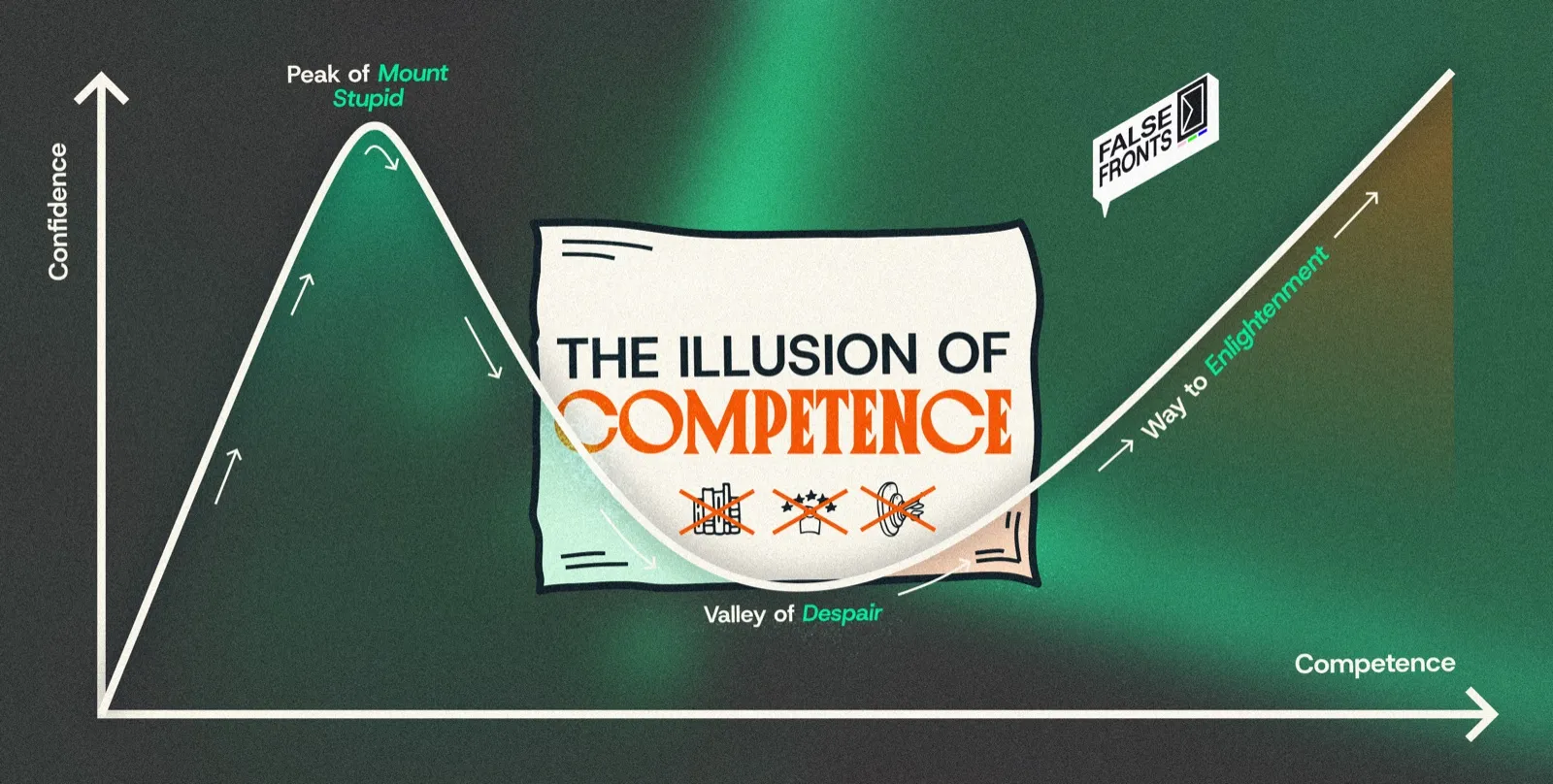
I wrote this after watching too many talented founders build businesses that deserve better brands than they have. It has something to do with the belief that understanding a thing somehow translates to mastering it.
I’ve always wondered why so many coaches and founders believe they can DIY their brand and the unforeseen costs that belief creates.
After reflecting on it, I realized I was really asking five questions that seem to be circling a single truth.
Why do so many smart people consistently overestimate their ability to build a brand?
The Dunning-Kruger Trap
Psychologists call this the Dunning-Kruger effect. It’s when a lack of knowledge hides itself so well that it looks like competence. This is why beginners often think they’re experts. Since they can’t see where they’re going wrong, they, of course, assume they’re doing fine.
There are four stages of learning any skill:
- Unconscious incompetence
- Conscious incompetence
- Conscious competence
- Unconscious competence
Most people live in the first stage when it comes to branding. They are not only unskilled, but they are also unaware of their lack of skill.
Then comes the moment of awakening: conscious incompetence. You finally start to see the limits of what you know. It humbles you. It hurts, but it’s the beginning of wisdom.
Later, you develop skill, but it still requires attention. That’s conscious competence. Eventually, when mastery settles in the body, it becomes unconscious competence. You perform without thinking because the craft is so internalized.
Yet many founders never make it past stage one with their branding. They assume their branding works because no one’s corrected them yet. This “illusion of competence” reminds me of the “it’s just a logo” thinking — the type of people that say “we’ll do it ourselves” — which ultimately results in poor branding.
What DIY Branding Actually Costs You
Poor branding costs you more than you think. It makes people trust you less, which forces you to spend more on marketing just to get noticed. Worst of all, it gets you confused with other brands. That means low recall and a weak reputation before you’ve even had the chance to build one.
From a design standpoint, DIY attempts are rarely it. Founders use fonts that don’t match the feeling they want to create, throw in too many colors, ignore basic design principles, and create inconsistent content. Each piece feels slightly off, but they can’t quite put their finger on why.
I often see logos that don’t work at small sizes on business cards. Designs that look fine on screen but fall apart in print. Missing proper file formats for different applications. Colors that don’t translate across different media.
I read in a post: one founder spent $46,000 over seven months on what was supposed to be a four-week, $7,000 rebrand. The scope kept expanding as DIY issues surfaced (all problems that a proper strategy could have prevented from the start).
But the most painful cost is that you lose clients you never knew you had. You attract what you put out, which means amateurish branding attracts bargain-hunting clients. Real prospects make snap judgments based on visual credibility.
So the real issue isn’t that the design might be disorganized; it’s that there’s no brand strategy to fall back on. Without a clear foundation (who you’re targeting, what you stand for, and how you’re different), every design decision will pretty much feel disorganized. That’s why DIY founders find themselves “fixing” something each time they create content. They’re trying to solve a strategy problem with design tactics.
The Purple Cow Problem
Some people believe, “If it ain’t broke, don’t fix it.” That might work for other areas of business, but in branding, it’s one of the biggest barriers to growth.
A great example of this is the premise of the book Purple Cow by Seth Godin. Picture driving past a field of cows, one after another: black, white, brown, over and over. Suddenly, you spot a purple cow. As your curiosity is shooting through the roof, you’d slam the brakes, right? That’s what happens when a brand truly stands out.
But most DIY brands are just another cow in the field. They’re forgettable and normal. Indistinguishable from the dozen other coaches or consultants in their space.
Why Founders DIY Anyway
I understand why founders start with DIY. It makes sense to keep costs down early on, especially when you’re still validating your business model. The problem with this is staying there too long.
At some point, most founders realize their DIY branding no longer reflects their evolved ideal client or premium positioning. Maybe they’ve hit consistent revenue, and the amateur brand feels inconsistent with their expertise level. Or they see competitors with professional branding and realize they’re being left behind. Eventually, the disconnect between their brand and their actual service quality becomes impossible to ignore, and clients stop coming.
If your branding no longer reflects who you are as a founder or the value you deliver, you’re actively working against yourself.
Three Questions to Ask Yourself
Ask yourself these questions to figure out if your brand is holding you back:
- Would I trust this brand if I didn’t know what was behind it? Look at your website, your socials, your marketing materials as if you’re seeing them for the first time. Be brutally honest. Does this look like someone who charges what you charge?
- Am I spending more time “fixing” my brand than building my business? If you’re constantly tweaking your logo, adjusting your colors, or redesigning your website instead of serving clients, that’s a symptom. You’re trying to solve a strategic problem with tactics.
- Do I sound like everyone else in my space? If your messaging, your visuals, and your positioning could apply to a dozen other businesses, you’re playing it safe. Normal (generic) brands don’t get remembered.
What Comes Next
Many founders eventually realize that strategy and design help connect with target audiences in ways DIY never could. The shift from unconscious incompetence to conscious incompetence is painful, but it’s also the moment everything starts to change.
You don’t need to figure this out alone. You don’t need to become a brand strategist on top of being a founder. You just need to recognize when you’ve outgrown the DIY approach (and be willing to invest in the brand your business actually deserves).
In reality, your business is probably better than your brand makes it look. And every day that gap exists, you’re leaving money and credibility on the table.
Eventually, DIYing it creates a huge disconnect between your brand and in-person services, and clients stop coming.
If your branding no longer reflects who you are as a coach or founder, it’s time to rebrand before it’s too late.
That’s it for this one. If you’ve found value in this piece—if it’s helped you think more clearly about your work—please consider subscribing wherever you follow 16th Form. It’s the best way to ensure more writing like this keeps finding its way to you.
Frequently asked questions
Why do smart founders overestimate their ability to DIY branding? The Dunning-Kruger trap: lack of knowledge hides itself so well that beginners assume competence. Many stay in DIY longer than validation requires, so the brand no longer matches their evolved expertise or pricing.
What does DIY branding actually cost you? It can create a gap between service quality and brand quality. When the brand looks amateur relative to the offer, clients stop coming and credibility and revenue are left on the table.
When should a founder stop doing brand work themselves? When branding no longer reflects who you are, when you spend more time “fixing” the brand than serving clients, or when you sound and look like everyone else in your space.
What three questions reveal if your brand is holding you back? Would I trust this brand if I did not know what was behind it? Am I spending more time fixing my brand than building my business? Do I sound like everyone else in my space?