
You post every day like they told you to without ever asking why. You spend time writing, editing, cutting your LinkedIn post for an entire hour, and it still doesn’t do the job you wanted it to do.
You don’t give people that unmistakable feeling that your brand is actually becoming something, yet you tell yourself that you need to be more consistent, to post more and study the algorithms and what they want this week, then the next, then the next like in an endless loop.
If you resonate with this, if this is currently you, then you’ve been doing content marketing without a brand. And without a brand, content marketing is an enormous waste of time, specifically in a very crowded market.
This article is about the disparity between what you’re publishing and what you’re actually building.
16th Form - Why Your Content Marketing Isn’t Buidling Your Brand
What Content Marketing Actually Means for a Personal Brand
Content marketing is, and most people would think we’re joking, not really understood by the masses. Ask ten people what it means, and you’ll get ten variations of the same answer:
- create content,
- build audience,
- sell to audience.
That’s actually an accurate answer. It is also a useless one.
For a coach in Lagos, a consultant in Nairobi, or a founder in Cameroon, content marketing should not primarily be about volume or reach. It should be about TRUST! Specifically, the sort of trust that makes a person on the other side of the globe decide you are the person they need before they even speak to you.
97% of marketers now have a content strategy. 61% of them report a performance improvement. But, and this one is cold: only 30% of marketers can accurately measure their social media ROI. This is a very practical lesson of people producing but not building.
87% of Kenyan small businesses spend on digital marketing. Only 12% see results. The gap between what they do and the outcome is not a posting frequency problem. This is clearly a purpose problem. And this purpose does not live in your content calendar. It lives inside your brand.
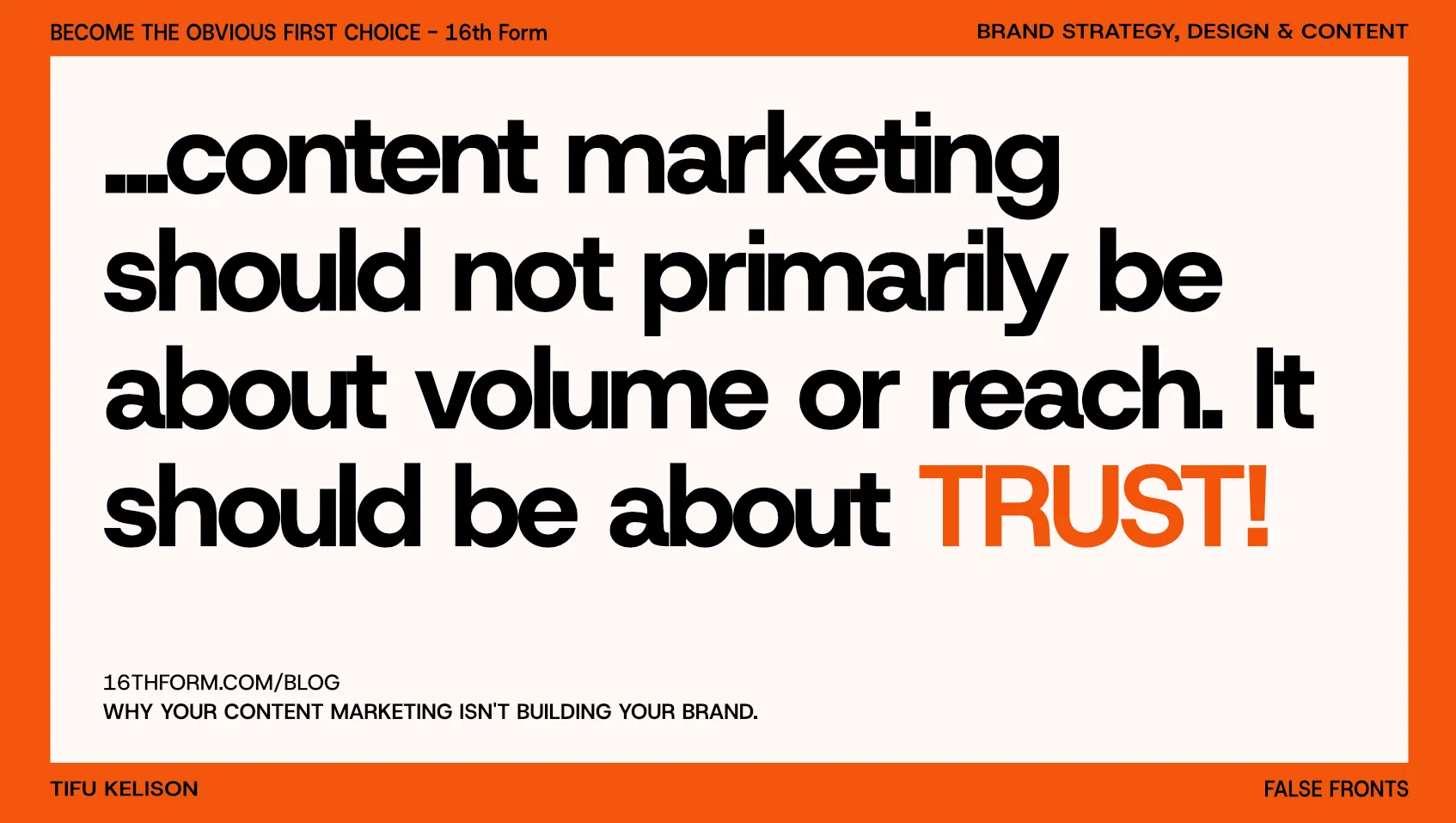
Content marketing should be about trust - 16th Form
The Difference Between Content Built to Perform and Content Built to Build.
Performing content will get you views.
Building content will get you remembered.
The difference is a thin line, but it changes the perspective and manner of approach completely.
You see, performing content means you are chasing the algorithm, and building content means you are training your audience to expect something specific from you.
The standard for what content should do is painfully blunt: your content should be good enough that a person on the other side of the globe would give you their email address to get more of it. That’s literally it. But this doesn’t tell you anything meaningful. It just tells you that you need to do more (more clicking).
But strong, thoughtful content comes from realizing the clutter, cutting it out completely and offering substance (information people can actually implement —today!), highly specific advice, and genuine insight. This is beyond conventional promotional messages.
Most content in the African digital space doesn’t clear that bar or even reach it. The creators are talented butt the content exists without a brand system underneath to give it weight.
Brand Identity is the Foundation Your Content Marketing is Missing
A million times, it’s been said: your brand identity is not your logo. No, not your color palette either. Not even the fonts.
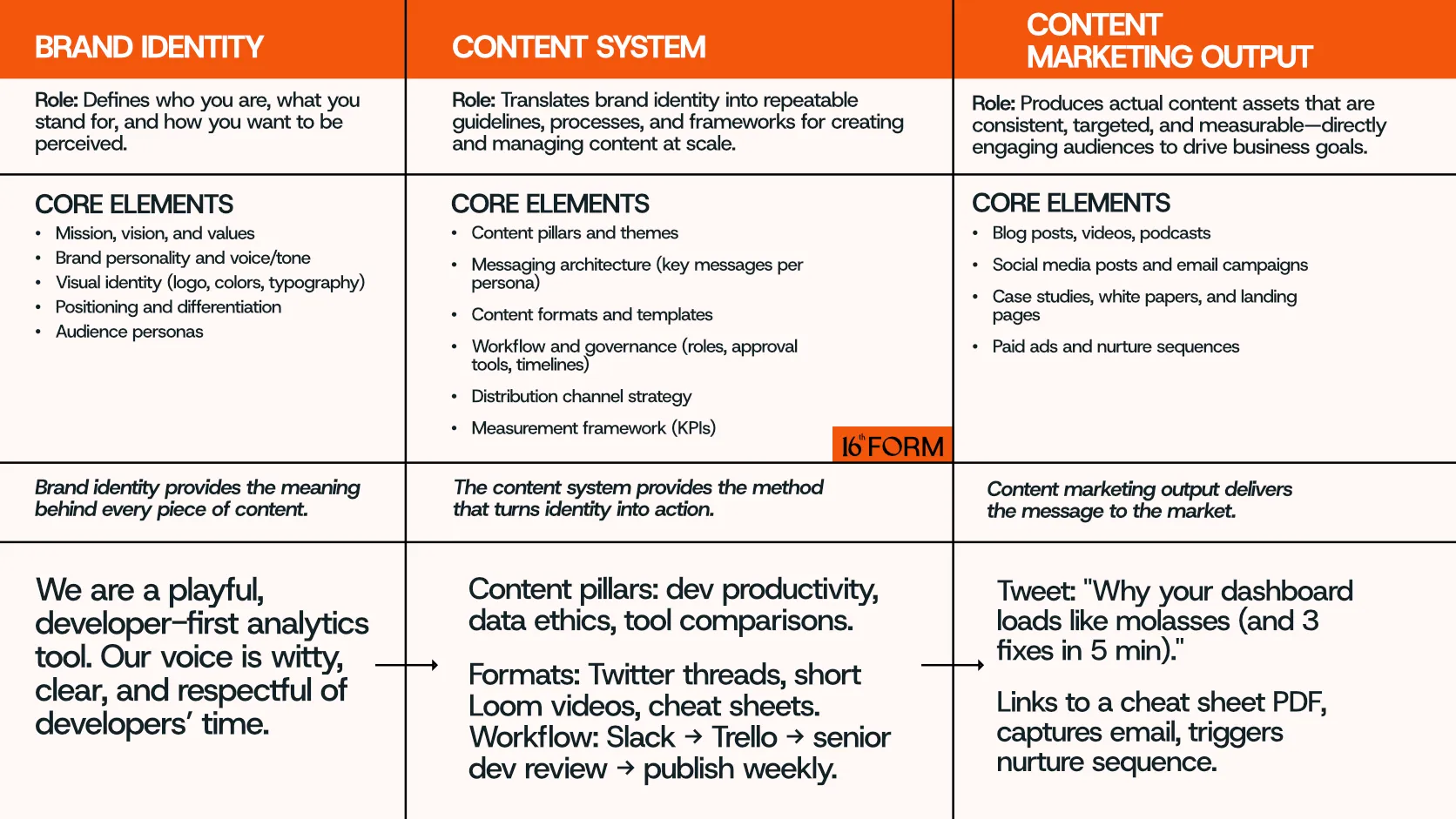
Relationship between brand identity, content systems, and content marketing output - 16th Form
Brand identity is the answer to a very specific question. The question of: when someone encounters anything from you (maybe a piece of content, your website, or a DM), what do they immediately know to be true about who you are and what you stand for?
If the answer is different (completely different) every time, then you don’t have a brand.
What Brand Identity Actually Controls in Your Content
Brand identity almost always does invisible work, and that work is present in every piece of content. It controls:
- Your voice: The specific way your brand speaks (leave out the tone, this is about the perspective that makes your content recognisably yours.) Without it, you’d sound like everyone else in your niche.
- Your visual language: The colors, and typography, even design decisions signal who you are to someone in about 10-15s. Research from the African Marketing Association confirms this; alignment between content and brand identity is more likely to affect how much people share and engage with your work. Unalignment actively harms it.
- Your positioning: The specific market position you occupy in your audience’s mind. Without it, your content has no argument to make. It’s just information. The type that can’t attract because it lacks a stance.
- Your audience filter: The right brand identity repels as powerfully as it attracts. It tells the wrong clients to keep scrolling and tells the right ones they’ve found exactly what they were looking for.
You see, every one of these is decided before you even sit down to write content. If you haven’t decided them, your content is deciding them for you. Inconsistently. Across a hundred posts, leaving your audience without a clear picture of who you actually are.
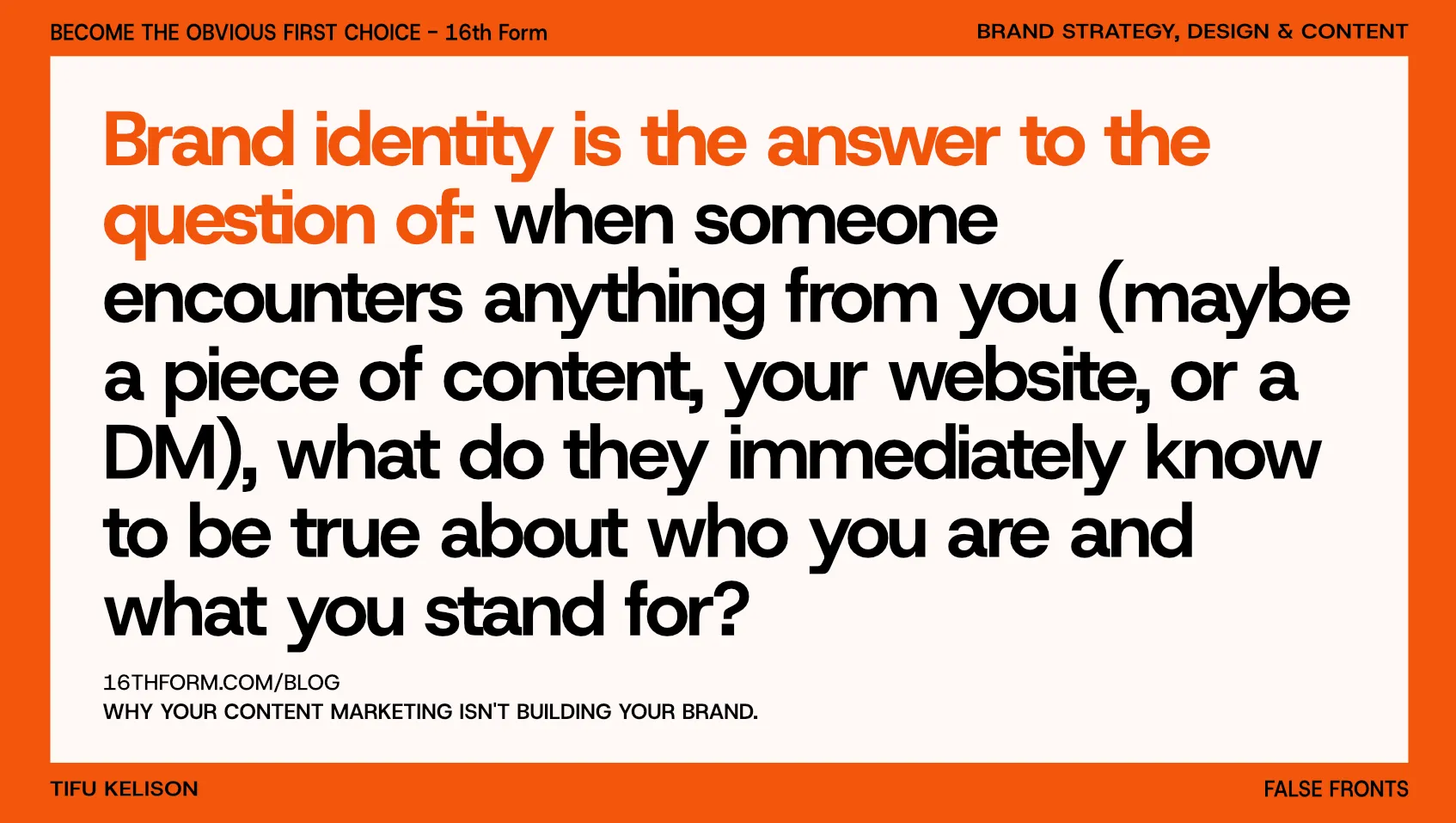
16th Form - Why Your Content Marketing Isn’t Building Your Brand
Why Africa Founders and Coaches Skip This Step (And What It Costs Them)
I’ve seen this pattern over and over. A coach launches their practice. Starts posting immediately because they’ve been told: “consistency is key”. The content may be good (it usually is not), and it may gain traction (it usually doesn’t), but it doesn’t convert.
Six months later, they have followers….
And no clients.
In markets like Nigeria and South Africa, where ad spend is increasing like crazy, projected to reach 84% of total ad spend in Nigeria alone, the noise is increasing faster than the authentic brands. In 2025, the African digital content market was valued at $1.5 billion and projected to hit $30 billion by 2032. This is an argument for better-positioned content.
There’s also a trust economy in the mix. In markets where formal institutions have historically been unreliable, trust is personal before it is institutional. People follow people. They trust voices before they trust brands.
The cost of skipping brand identity is invisible for a long time. And like most things, suddenly it isn’t. You’ll be posting on the vast internet with zero engagement and won’t know why.
How to Build a Content Marketing Strategy Rooted In Brand Identity
This is a thinking framework. Built it once, and properly, and every content decision you make from here gets easier.
Step 1: Define What Your Brand Stands For Before You Write a Single Word
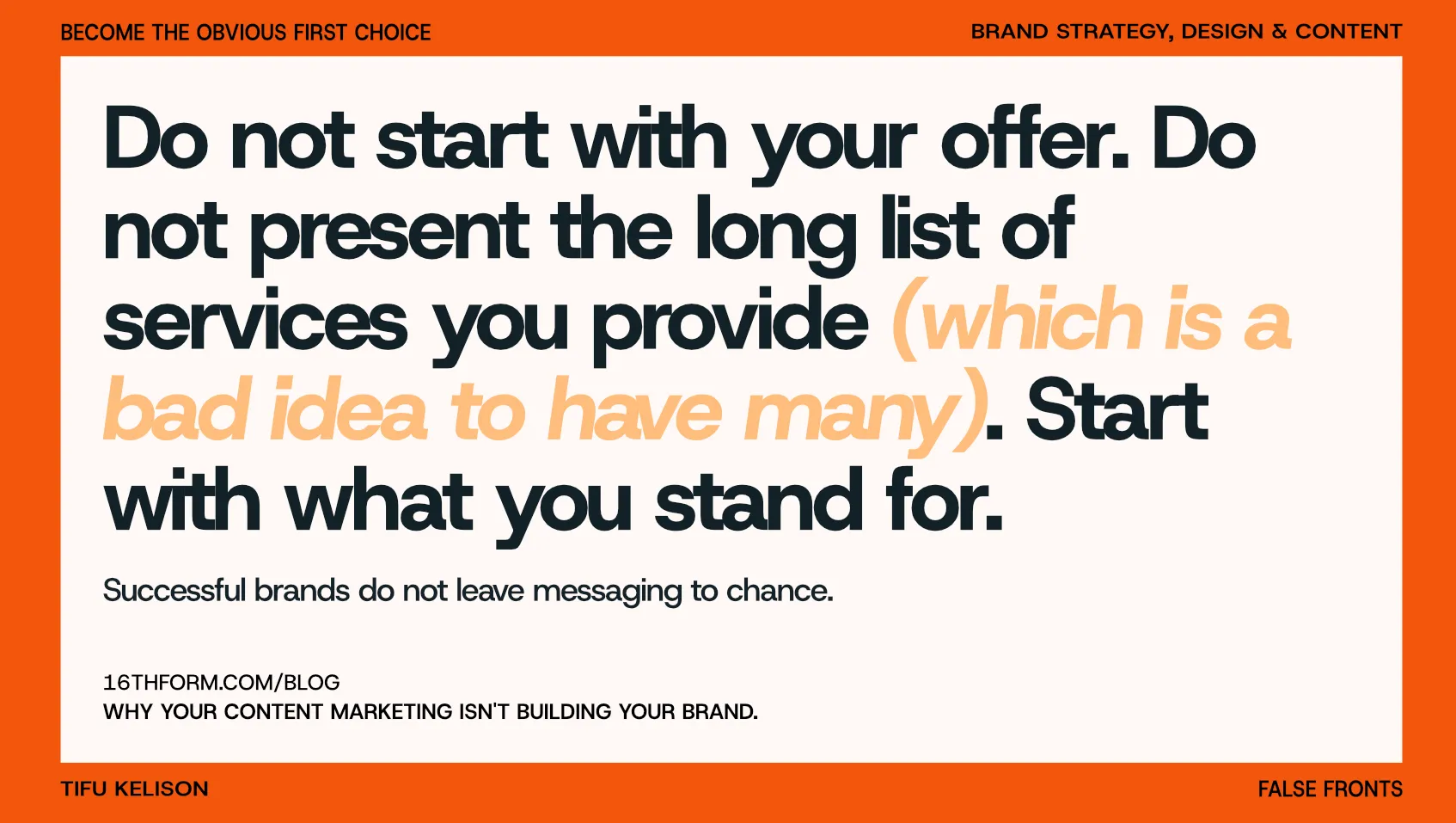
Do not start with what you offer. DO not present the long list of services you provide (which is a bad idea to have many). Start with what you stand for.
Successful brands do not leave messaging to chance. They engage it with a strategic foundation (a clear positioning statement and specific messaging pillars that every piece of content is built on top of).
For a founder or coach, that foundation answers three questions:
- What do you believe that most people in your space don’t? (No answer? You haven’t thought about it enough.)
- Who specifically are you for (and who are you not for)?
- What does someone’s life or business look like after working with you?
When you can answer those questions with precision and without hesitation, you have the raw material for a brand. Before that, you’re guessing.
Step 2: Design a Content System Instead of a Content Calendar
A content calendar tells you what to post. A content system vets if this is worth posting, and tells you if it solidifies the idea of your brand even more.
The system starts with your brand positioning and works outward (it works from the inside-out): what are the three to five themes that your brand owns? What type of content proves those themes (education, narrative, opinion, or demonstration)? What does each piece of content need to do to earn its place?
53% of B2B markets report that content marketing directly increases sales and revenue, but only when built on a strategic foundation.
Businesses publishing 16 or more blog posts per month see 4.5 times more lead growth. But volume without a system is large-scale fluff. The question should’ve never been how much you should publish, but whether every piece you publish adds a layer to the brand you’re building.
Step 3: Use Content to Prove Brand Identity, Not Explain It
This is exactly where most people get it wrong.
Don’t tell people what your brand is.
Show them.
A coach who constantly posts about how they “help clients find clarity” is explaining their brand. A coach who posts a specific framework they used to help a Lagos-based founder restructure their entire revenue model, is proving their brand.
The difference is large. Explaining is easy to ignore. Proving is almost impossible to scroll past.
Ayokunle Odebiyi, a Nigerian brand strategist, generated 223 million impressions and a 25.46% conversion rate for the Ehingbeti Lagos Summit by creating content deeply rooted in cultural specificity and strategic clarity rather than just posting more. The content proved a point of view.
16th Form - Why Your Content Marketing Isn’t Building Your Brand
What Great Content Marketing Looks Like for an African Brand
Coca-Cola’s “Achalugo” campaign in Nigeria went viral because they banked on relatability while still being able to be regarded as a viral sensation. It proved the brand rather than explaining it.
Lafarge Africa’s “Women on Wheels” campaign won awards in Nigeria by using highly targeted storytelling that spoke to a specific audience with respect. The content had a brand underneath it. That brand has a point of view.
If there’s one thing you should know, it is that you don’t need Coca-Cola’s budget. What you need is their discipline.
The discipline of knowing what you stand for before you create anything. The discipling of building a visual and verbal identity that makes every piece of content feel like it came from the same place. The discipline of measuring content by a simple, and unforgiving standard:
Is this content good enough that someone on the other side of the globe would give me their email address to get more of it?
That standard changes everything. It’s why 81% of marketers using AI to scale content are increasing the noise problem. AI scales production, but it cannot replace identity. The brands of the future will be the ones that are unmistakably themselves.
For African brands specifically, where 75% of Gen Z skip ads, 69% find most ads irrelevant, and trust is earned through authenticity, being unsmistakably yourself is not a differentiator. It is merely a requirement.
Your Content Is a Mirror of Your Brand
This part is the most uncomfortable to sit with: Your content is already showing people your brand.
The question is whether that’s the brand you intended to build. Inconsistent content shows an inconsistent brand. Generic content shows a brand with nothing specific to say. Perfect but empty content shows a brand that looks the part but hasn’t done the thinking yet.
And the reverse is also true. Content that is guided by a clear identity (speaks in a consistent voice, with a recognisable visual language, and has an actual point of view) is content that builds something.
That’s what content marketing is supposed to do.
But many brands never get there.
It is most likely because they started content before they started brand, and they don’t know how to reverse the scales.
If you’re ready to build the brand first (and become the obvious first choice in your market while at it) - Start with brand strategy and Identity at 16thform.com
Frequently asked questions
Why isn’t content marketing building my brand? Most founders post for volume or performance before they have brand identity. Content without a strategic foundation becomes generic or inconsistent, so it may get attention without converting or building a clear brand.
What is the difference between content built to perform and content built to brand? Performance content chases reach and metrics. Brand-building content is rooted in positioning and identity so every piece reinforces the same point of view, visual language, and voice.
How do you build content marketing from brand identity? Define what your brand stands for first (beliefs, who you are for and not for, and the after-state). Then build a content system around three to five owned themes and use content to prove the brand, not just explain it.
What should African founders and coaches focus on in content? Trust is personal before it is institutional in many African markets. Discipline beats budget: know what you stand for, stay consistent in voice and identity, and measure whether content is strong enough that someone would give their email for more of it.