
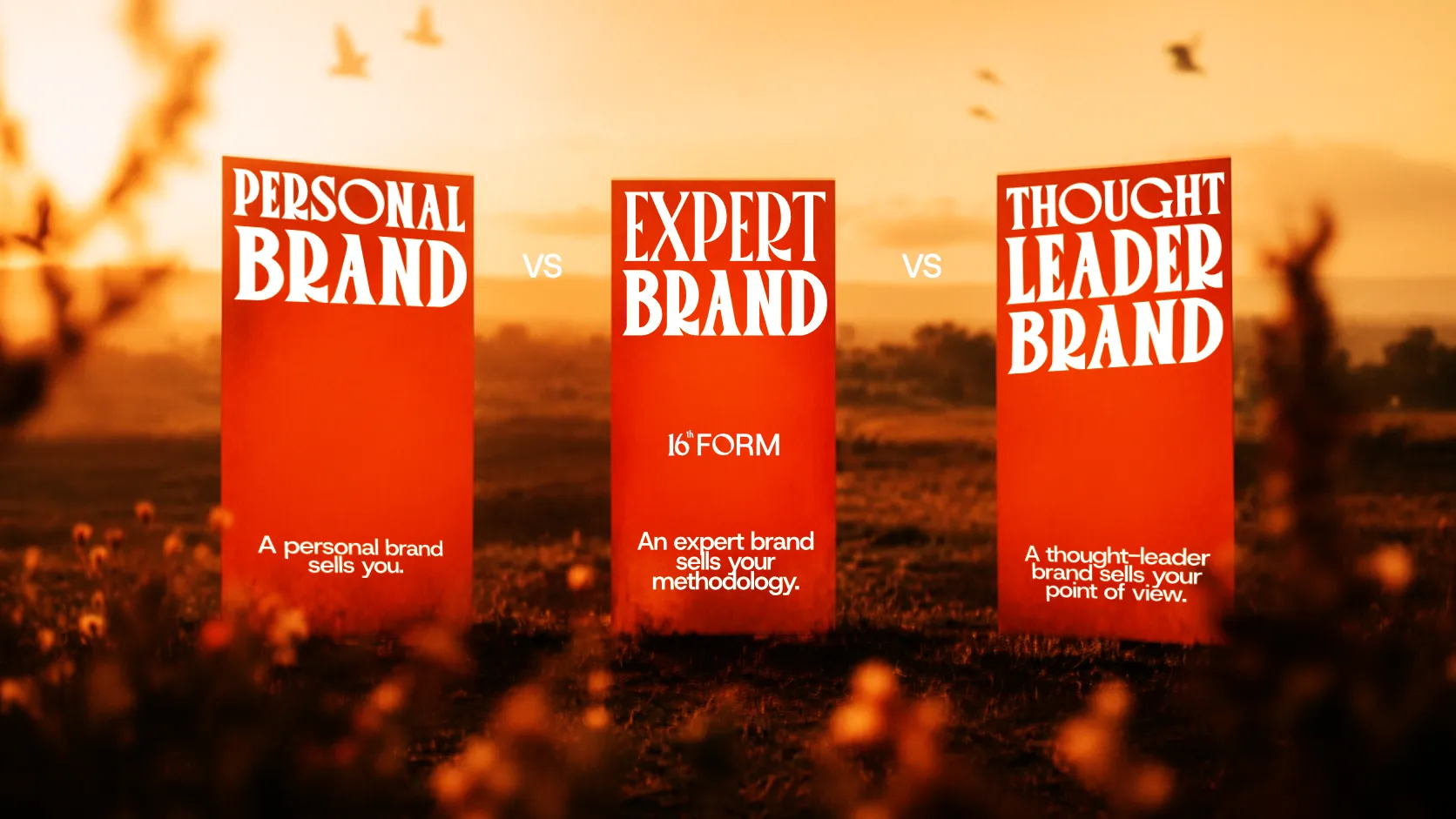
A personal brand sells you. An expert brand sells your methodology. A thought-leader brand sells your point of view.
They are not a hierarchy. Not three stages of the same journey. They are three different commercial machines with different fuel and different ways of going broke.
Most founders and coaches think they are building one of them (which is usually the personal brand). That is why the content gets attention, and the offers make them no money.
This article fixes the category confusion.
What Each One Actually Is
Personal Brand
What people associate with you as a human. The product is recognition. The audience is followers. The economic model is access.
Tiwa Savage has one of the largest personal brands in West Africa. She has never become a thought-leader. When she enters fashion or beauty deals, she is not selling expertise in design or formulation. Her path did not go from personal to expert. She is renting her personal brand to a category that wanted the association.
The personal brand pulled product opportunities toward it. She did not spend years grinding in the fashion category.
Expert Brand
What people associate with your capability in a specific domain. The product is your methodology and your track record. The audience is buyers who have a problem you solve. The economic model is paid work.
The senior surgeon who has done 2000 operations and is the person other surgeons refer their hardest cases to has a massive expert brand. Most have zero personal brand and zero thought-leader brand.
These are expert brands. Most of the world's most expensive professionals run one.
Thought-leader Brand
What people associate with your ideas about a field. The product is your point of view, your frameworks, your stance, your willingness to disagree in public. The audience is peers, journalists, decision makers, and other operators. The economic model is influence converted into IP.
Marty Neumeier was a working brand consultant whom very few people knew. He wrote The Brand Gap. The book did the thought-leader work. The personal brand came after, as a consequence of the ideas.
April Dunford runs a thought-leader brand. Seth Godin runs a thought-leader brand.
These brands are 3 different things operating in 3 different rooms.
The Difference At a Glance
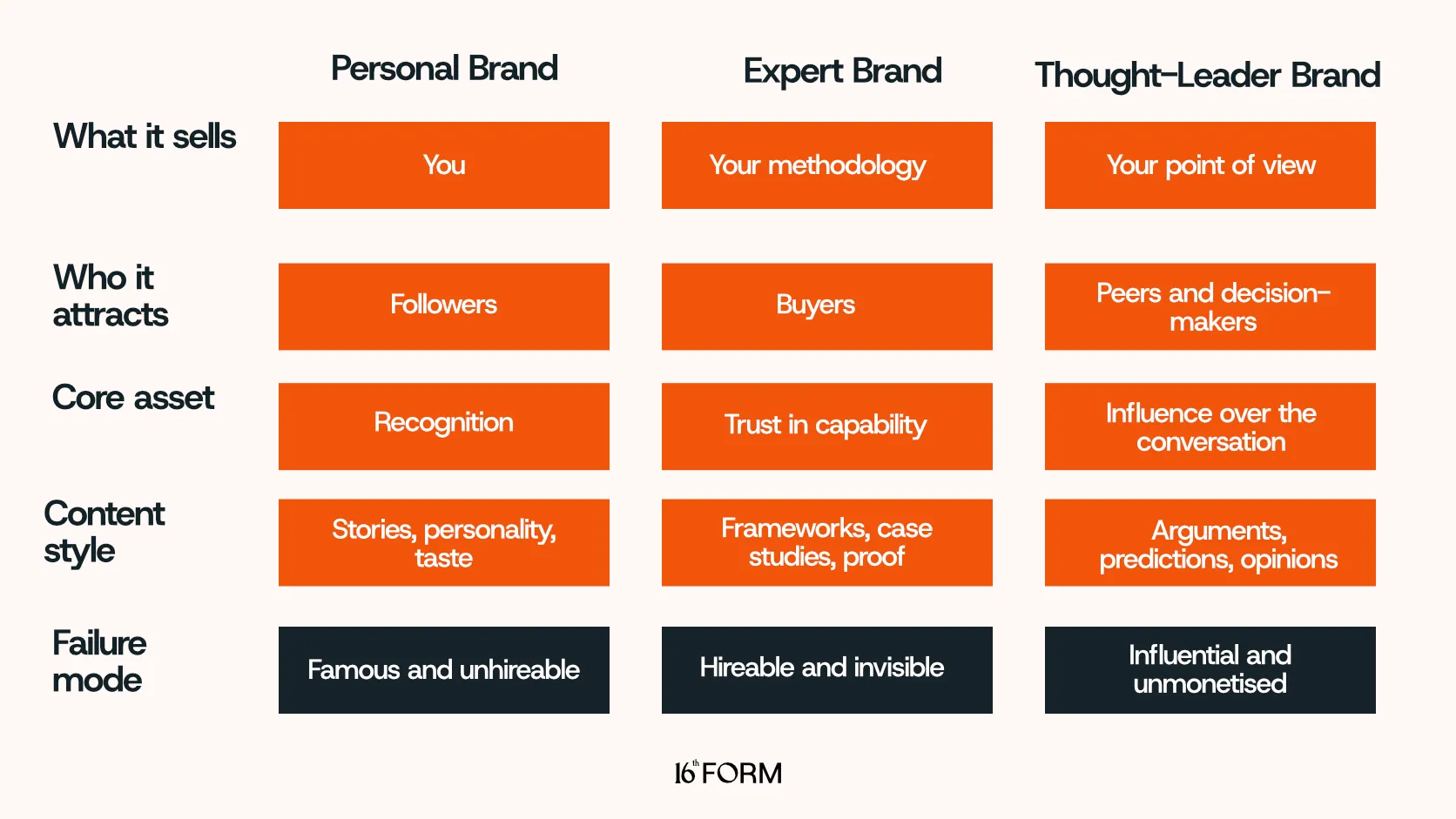
Read the failure modes carefully. That is where the money you are losing actually goes.
The Three-Mirror Test
Most founders assume they are building a personal brand. They cannot tell which brand they are building because they look at their intentions. They should be looking at the evidence.
Mirror one: Your last ten posts
Are they actually about you? About how you work? Or about what you believe? The dominant theme is the brand you are actually building, even if that was not your intention.
Mirror two: Your inbound.
Look at the DMs and the inbox. Fans telling you they love your energy. Prospects requesting proposals. Peers are inviting you to debate or co-sign. The 3 audiences send 3 different kinds of messages. You are getting whichever one your content earned.
Mirror three: Your offers.
What are you actually selling? Access to you? A service tied to a methodology? Your IP packaged into a product?
Each one builds a different brand. If the brand you say you are building does not match the offer you are charging for, the brand is misdirected.
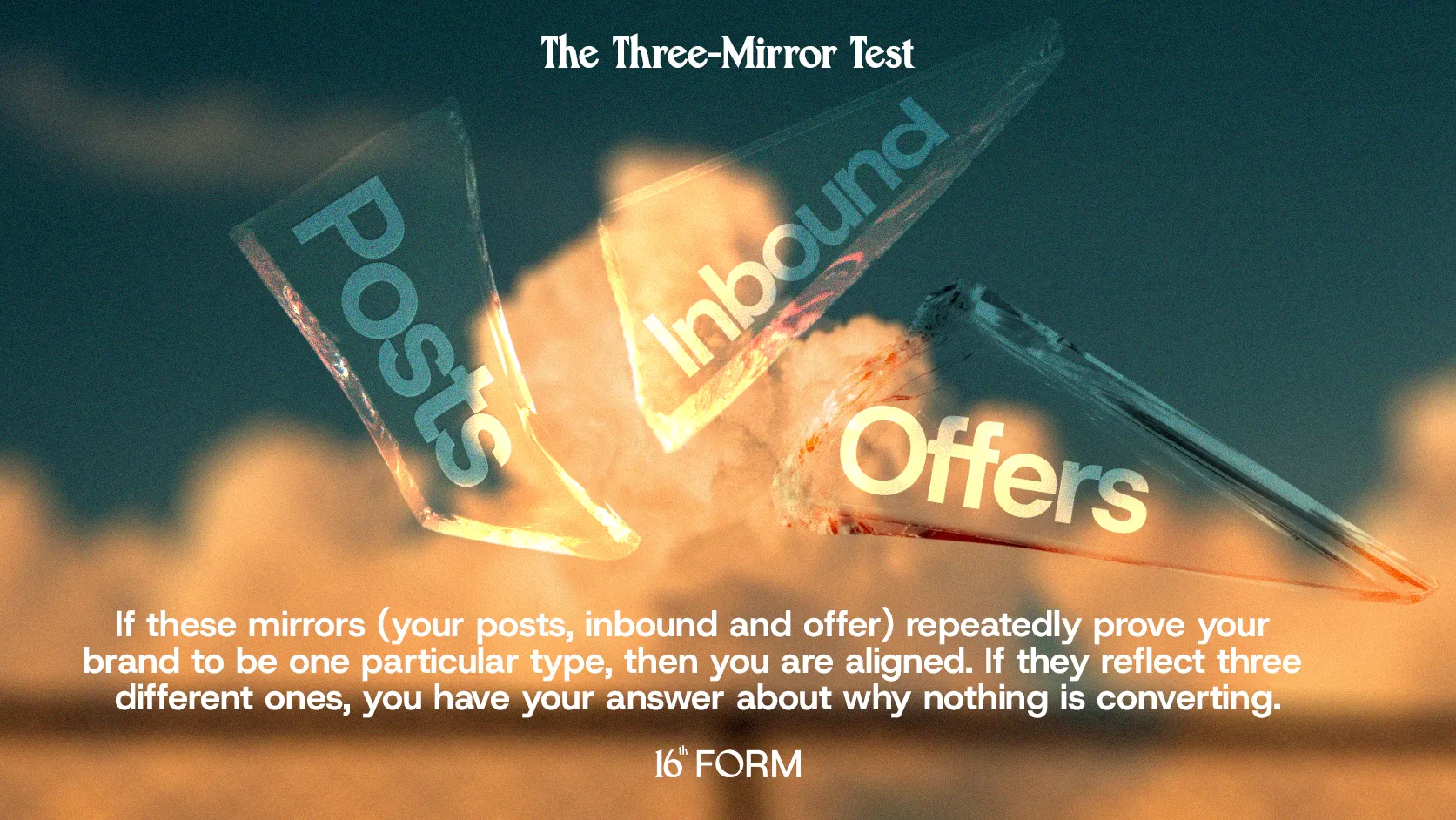
If these mirrors (your posts, inbound and offer) repeatedly prove your brand to be one particular type, then you are aligned. If they reflect three different ones, you have your answer about why nothing is converting.
Why credentialed experts build the wrong one
This is the part most coaches do not want to hear.
You have an expert brand. You spent years learning, earning the credentials, doing the thing, building a library of proof, and you actually have a real and unique methodology.
Then you go on LinkedIn and start posting like a personal brand. Things like vulnerability posts and origin stories. You do it because that is what the algorithm rewards, and that is what the loudest gurus tell you to do.
This will get you engagement with zero clients.
The audience you built is there for you. They came because you were charming, and not because they had a problem you could solve. That was you optimizing for the wrong asset.
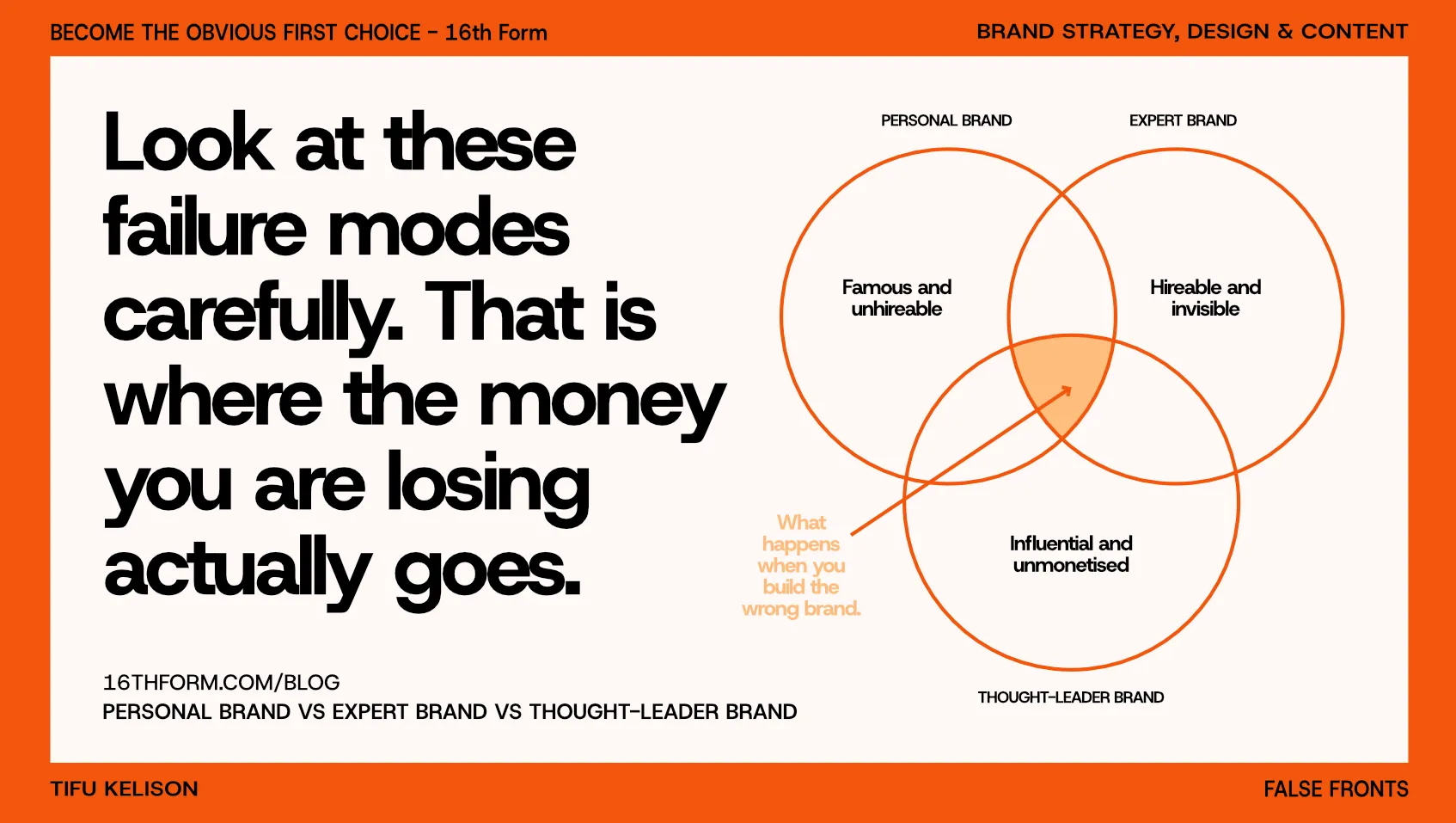
In five years of building brands for credentialed founders and coaches, I have not met one who was running the brand they thought they were running. The brand they wanted and the brand their content was actually constructing did not overlap, and that loses revenue.
The expert brand may be your moat. Filling it with personal-brand content because personal-brand content gets more eyeballs is diluting your expertise.
Which One Should You Build First?
Pick the one that matches how you make money.
You sell one-to-one services.
Expert brand is the foundation. You decorate it with your personal brand, and the thought-leader brand expands it later. If you skip the expert brand and lead with the other two, your funnel will fill with admirers and people who want to pick your brain.
You sell courses or books.
Thought-leader brand is the ideal. Personal brand can drive traffic. An expert brand provides the proof that you are allowed to have a point of view in the first place.
You sell community, membership, or access.
Personal brand is the engine.
It is important that you do not skip the order. Building the wrong brand for your business model is the most expensive marketing mistake founders make. It is also the easiest to make, because it looks like work the whole time.
Last bit
Whether personal, expert, or thought-leader, they are different commercial assets that can be built in sequence, but more often than not, the order changes based on the business model.
Every brand carries traces of the other two. You cannot have a pure expert brand with zero personality (the human is still there). You cannot have a pure thought-leader brand with zero credibility (the ideas have to come from somewhere).
Pick the one your business actually runs on. Build it on purpose. Stop accidentally constructing the other two and wondering why nothing fits together.
Frequently asked questions
Can you have all three?
Yes. The best operators do. They build them in sequence, not at the same time. One of them is always doing the commercial work while the other two amplify.
Is an expert brand the same as a personal brand?
No. A personal brand sells your presence. An expert brand sells your capability. They overlap in the messenger and diverge in what is being bought.
Do thought leaders need a personal brand?
Some scale faster with one. Most do not need it. The point of view is the asset. The personality is a multiplier on the asset. It is not a substitute for it.
Which brand should a coach or consultant build first?
Expert brand. The methodology is what the buyer is paying for. Build the methodology for your brand first, then layer the other two once the foundation is paying.