
Right now, someone is starting a business. He just launched a newsletter and started publishing long-form content (articles only, the serious stuff), then moved to notes to see what all the fuss is about.
Then one note, one that was particularly off-brand, got more engagement than usual.
So he thinks, "I just need more notes like that. Maybe I can get more engagement that way." So he proceeds to post a few more notes… like that
And the stats go up.
(okay, wait! We both know it doesn't play nice like that on Substack, but carry on for the sake of the story)
He is happy. The algorithm is happy. Everyone is happy.
This is a problem because;
Almost everyone measures growth by the opportunities they said yes to.
Very few measure it by what they said no to.
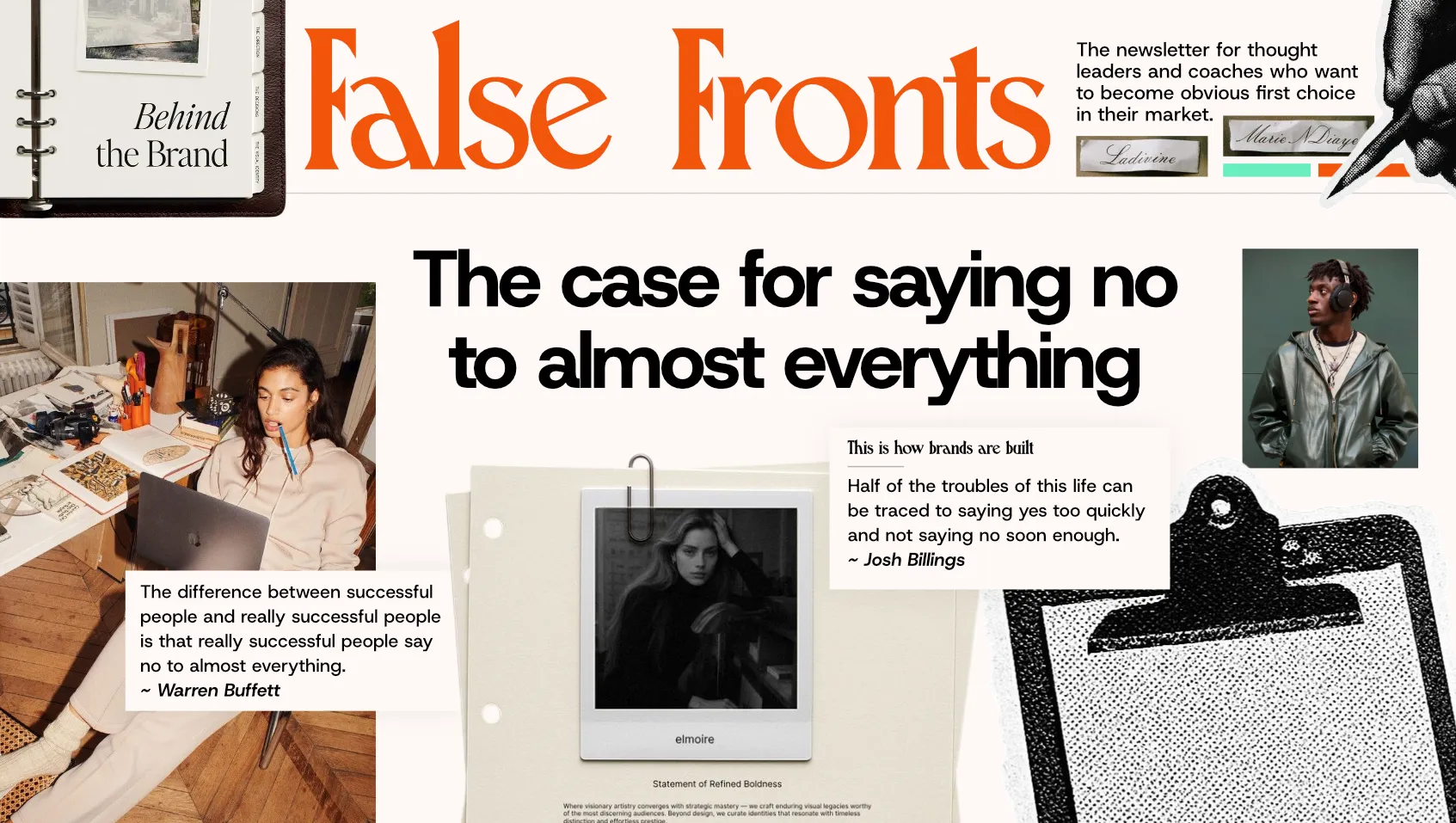
Going off brand…
Going off-brand is beautifully easy. You just need a tiny stack of yeses (which seem harmless) but compound into a brand you won't recognize.
It always feels like growth because it gives you a somewhat similar feeling to what growth actually looks like.
(brace for impact)
Most people go off-brand because they don't know what their brand is in the first place.
My work revolves around providing my clients with clarity on what their brand is and what it is not. I help them to understand what their brand is NOT because the contrast, what it is not, is equally important. If not, more important than what is.
So yes, going off-brand is easy.
Why Saying No Feels Irresponsible
Everybody wants growth. So when it shows up, saying no feels insane. You'd be nuts to miss the chance, right?
Picture this. You run a small branding studio. You're good with early-stage food and beverage brands; that's your corner of the world. Then an email from a mid-sized logistics firm comes in. They've seen your work. They love it. They want a full rebrand, and the budget is double what you usually charge + it's a slow quarter.
You say yes. Obviously. Saying no would feel stupid. Irresponsible, even. Anyone watching you would call it the smart move.
This is the issue. It doesn't look like a mistake, but maturity, or growth, whatever you call it.
A few things are pulling the strings here, and they're worth naming.
Scarcity thinking is one of the biggest reasons people feel safe saying yes.
If everything you've lived through has trained you to expect less, then a big opportunity's going to feel like a threat, you'll be thinking you're going to fumble. So you grab whatever's in front of you, because who knows, then the next thing comes around.
Fear of missing out.
The dread of watching someone else take the thing you walked past.
Validation.
You want people to agree with you because agreement feels like proof you're doing it right. (It isn't. We'll get there)
And revenue pressure, the loudest one of all.
The quarter's slow, and the wrong client is standing there waving money at you.
What You Call Growth, Your Customer Calls Confusion
Saying yes feels good because it feels like everyone agrees with you. And being agreed with is one of the best feelings there is.
But while you're enjoying it, you're letting your ego make a decision your strategy should've made.
Every tiny yes does something you're not aware of in that moment. A new type of client means a new audience. A new audience means new positioning. New positioning means new content and promise. And a new service won't just sit next to the old ones, so it drags your positioning sideways too.
Branding is wired into everything a person experiences with you. Pull one thread, and the thing starts falling apart. Most coaches never trace where the thread is headed. They just notice something feels off, and by then it's a thousand decisions too late.
Why Every Yes Might be a Bad Idea
Just one decision can't dilute a brand. That's the trick of it.
It's always the small ones, stacked. The first off-brand is totally harmless. And if it stayed a one-off thing, he'd be fine. But off-brand tends to work, at least at first, so you do it again. Until you cross the line.
By the time you look back, you're somewhere you can't easily walk back from. This is actually where most rebrands come from. For some people, it's genuine growth, but for others, it's a mistake.
The thing that's not often said is that rebrands are a confession. Most of them are dressed up as evolution. But most of them are, under the surface, an apology. A particular moment you admit, without admitting lol, that you lost the direction somewhere around the 60th yes, you made.
Like I said, some of those small changes are good. Brands grow because the people running them grow. I speak with solo operators, and they learn fast, which means they're making these calls almost every day. The ones who really get it make the changes on purpose.
Simple is the Most Expensive Thing to Build
Great brands look simple. Almost too simple. Obvious, even.
Simple did not come easy to them. It's because, over time, they understood the complexity well enough to cut it. Simple is what's left after you remove everything that was weakening recognition. Recognition is subtraction.
The surprising part is that simplicity is expensive to build and cheap to run. You pay upfront, figure out the type of yeses that should've been no's and all the trends you should sit out, and then it compounds for years. Complexity is the reverse. Free at the start, because you say yes to everything, and then it slowly cripples you with confusion.
Hint: most people choose complexity. I bet you're thinking about someone who chose complexity right now.
Even look at the internet right now. Everyone's nostalgic. The old things, the plain things, we want them back, even the people who weren't alive for them. That tells you something.
One warning tho. Simple is not dumb. I'm not telling you to dumb anything down. No, no. You write to an audience that already knows how it likes to be spoken to. Simple means clear, not baby language.
Why Your No's Are the Real Positioning
The most useful way you can think of strategy is as a lens
Put on the lens, and every opportunity has to pass through one question: Does this strengthen the position I'm trying to own? Not "is this good money." Not "will people like it." Just that. Does it make me more of the thing I want to be known for, or less?
If it doesn't strengthen the position, cut it out. Find a workaround, or go build your own version of the trend instead of copying the exact someone else made.
If you're wondering, the actual way to position your brand is with your no's. The things you say no to. Not the ones you say yes to. It's something you decide, over and over, it's what you refuse to be.
So you definitely can't think your way to a position in one sitting. You subtract your way there. That's why positioning is only solidified after you've gotten some clients.
Most Things Deserve a No
Most things. Most of what lands on your desk is a distraction wearing a good outfit. The job is learning to spot it fast and remove it faster.
Four kinds are worth watching for.
- Clients who pull you out of your position
- Services that blur your expertise
- Content and topics that pull the wrong crowd
- Trends that hand you attention but cost you identity.
I keep feeling like I should hand you a clean framework here. But you don't need it. You need one question asked before every decision: if I do this, what will I have to do next?
Doesn't make sense? Go ahead and try it.
One more thing. Anyone can copy your content, your logo, or your visual identity; all of it is stealable. But nobody can copy the things you said no to because they don't know them.
Frequently asked questions
Why is saying no important for brand positioning? No’s are the real positioning. Strategy is a lens that asks whether an opportunity strengthens the position you want to own. You subtract your way to a position more than you invent it in one sitting.
Why does saying no feel irresponsible when you are growing? Growth culture treats every yes as progress. But every small yes compounds into a brand you may not recognize—clients, services, content, and trends that pull you off position.
What should you say no to most often? Clients who pull you out of your position, services that blur your expertise, content and topics that pull the wrong crowd, and trends that hand you attention but cost you identity.
What question should you ask before every brand decision? If I do this, what will I have to do next? And: does this strengthen the position I am trying to own—not only whether it is good money or popular.